|

Fig 1

Fig 2
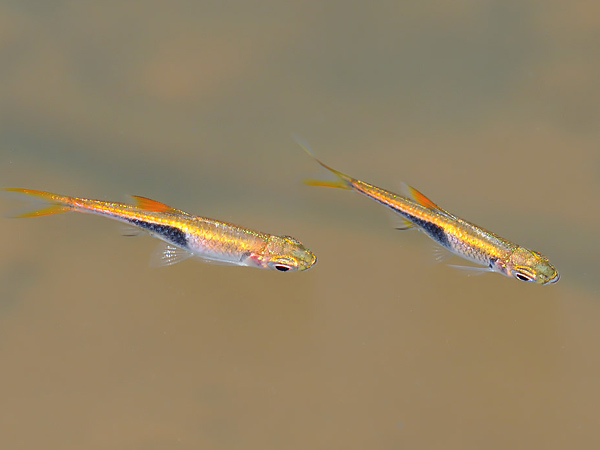
Fig 3
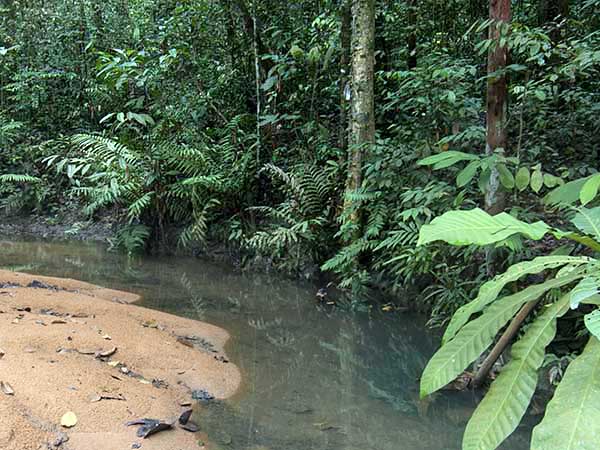
Fig 4
|
Order : Cypriniformes
Family : DANIONIDAE
Species : Trigonostigma heteromorpha
Total Length (includes tail fin):
50 mm
(Ho et al, 2016)
Standard Length (excludes tail fin) : 35 mm (Tan, 2020)
Trigonostigma
heteromorpha (Harlequin Rasbora) is one of the largest of the 5 known
species of Trigonostigma (as of 2026); it can grow to 35 mm SL
(standard length, which excludes tail length) and a total length of 50 mm
(which includes tail length) (Ho, 2016, Tan, 2020).
This small fish inhabits shaded, or partly shaded, lowland forest streams,
typically where acidic conditions occur such as peat swamps and freshwater swamp
forest; it can tolerate a pH range of 5.0 to 7.0 (Fishbase, 2026). It is a gregarious, shoaling species, which often congregates with other
rasboras and barbs.
It is deep-bodied and laterally compressed. In the field it can be
identified by the black, triangular patch (or 'axine') at the posterior end
of the body. Its upper body is reddish-gold, and its abdomen is pale. The
tail fin is deeply forked; both the tail fin and dorsal fin are typically reddish-orange in colour,
but other fins are typically much paler.
This species is benthopelagic, being mainly active in mid-water; it sometimes
occurs in very shallow streams. Its diet comprises aquatic invertebrates,
particularly small insects.
Fertilised eggs are laid onto the underside of submerged leaves and other
surfaces; to achieve this both male and female must assume inverted
positions (Tan, 2020).
Trigonostigma heteromorpha occurs in many states of Peninsular Malaysia (e.g Perak, Selangor, Negeri Sembilan, Johor and Pahang), Singapore, and parts
of Sumatra (North Sumatra and Riau provinces, include larger islands of the
Riau Archipelago) (Tan 2020).
Populations of Trigonostigma in southern Thailand and northeastern
Peninsular Malaysia (i.e. Terengganu state) are now recognised as a newly
described species, namely
Trigonostigma truncata (Tan, 2020).
Figs 1 to 3 : Examples from shallow forest streams with sandy substrate
in
Singapore.
Fig 4 : Lowland forest stream with sandy substrate in mature secondary
forest in Singapore.
References and links :
Ho Jonathan K. I., Sorain J. Ramchunder, Andrew Memory, Meryl Theng, Li
Tianjiao, Esther Clews, Cai Yixiong, Tan Heok Hui & Darren C. J. Yeo. (2016). A
Guide to the Freshwater Fauna of Nee Soon Swamp
Forest. Singapore: Lee Kong Chian Natural History Museum & Tropical Marine
Science Institute, National University of Singapore. 139 pp.
Tan, H.H., 2020. Trigonostigma truncata, a new species of harlequin
rasbora from Malay Peninsula (Teleostei: Danionidae). Raff. Bull. Zool.
68:421-433.
Fishbase - Trigonostigma
heteromorpha
|


