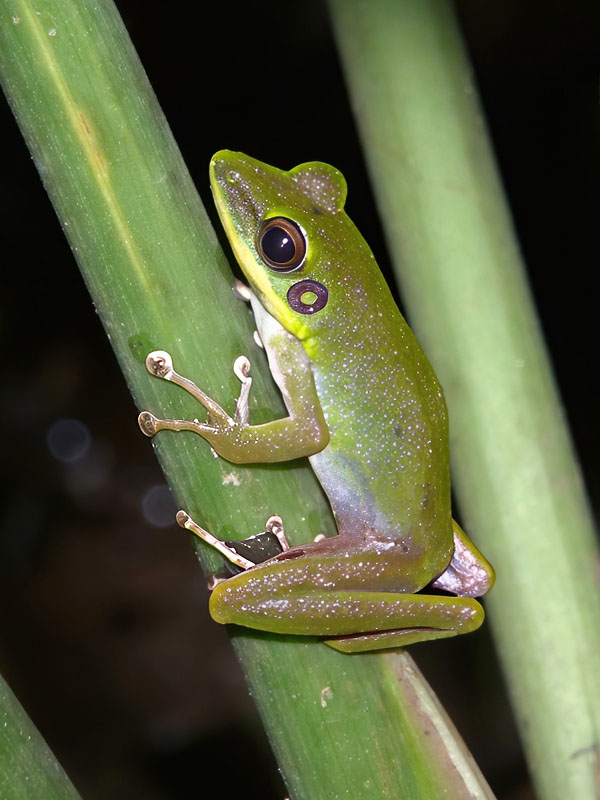
Fig 1

Fig 2

Fig 3

Fig 4

Fig 5

Fig 6

Fig 7

Fig 8
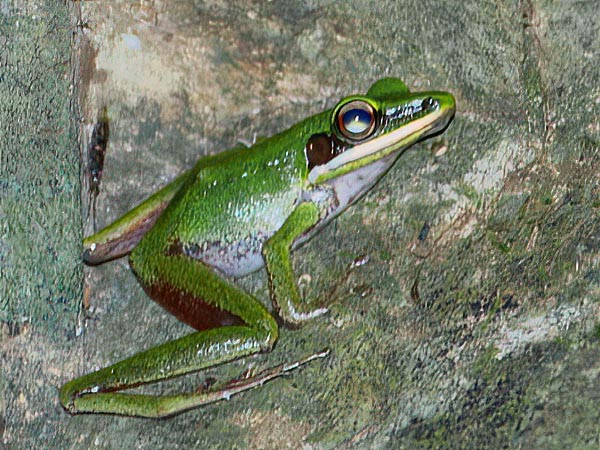
Fig 9
|
Family : RANIDAE
Species : Hylarana labialis
Size (snout to vent) :
Female 7 cm, Male 4.5 cm
Play call
►
Hylarana labialis (Copper-cheeked Frog,
Malayan Copper-cheeked Frog) occurs in shallow streams in lowland primary,
regenerating secondary forest, and freshwater swamp forest.
The taxonomy of this, and other closely related frogs in the region, is
still not fully understood; the images on this page
should be seen as comprising a species group, rather than a single
species.
Adult Hylarana labialis typically perch low down on streamside
vegetation, or fallen twigs and branches. They are small in size, measuring up to 7 cm but
generally less than 4 cm.
Their skin colour can be variable, comprising various shades of green, yellow and
brown with minor speckling on the dorsum and hind legs. The species is best
identified by the large, brown eardrum, and pale lips.
The snout is pointed, and there is generally a dark stripe extending from
the eye to the tip of the snout.
The hind legs are long and slender, and the fingers and toes have rounded
pads. There is dark webbing between the toes on the hind feet.
The tadpoles are distinctive (see images below); these are to be found occur in quiet,
shallow pools along forest streams.
In Kedah, Peninsular Malaysia a study of their diet showed it to be
predominantly insects, including termites, ants, mosquitos and orthoptera
(grasshoppers and related insects). (Yap Chee Hui & Ibrahim Jaafar,
2012).
Hylarana labialis occurs in southern Thailand, Peninsular Malaysia
and
Singapore. Included here are two possible examples from islands in the Riau
Archipelago, Indonesia (Figure 7 and 8).
Fig 1 : Example from Kledang Saiong, Perak, Peninsular Malaysia clinging
to streamside vegetation in logged lowland forest.
Fig 2 : In primary lowland forest at Kota Tinggi, Johor, Peninsular
Malaysia.
Figs 3 and 4 : Two examples next to a clear, mountain stream at Gunung Pulai, Johor, Peninsular
Malaysia.
Fig 5 : Clinging to streamside grasses in freshwater swamp forest, Singapore.
Fig 6 : Pale specimen from Singapore's central forests.
Fig 7 : Green specimen from Singapore's central forests.
Fig 8 : Example from a narrow stream in coastal forest at Pulau Sugi, Riau Archipelago, Indonesia.
Fig 9 : Example from a rocky stream on Bintan Island, Riau Archipelago, Indonesia.
References :
Hui, C. Y., & Jaafar, I. B. R. A. H. I. M. (2012). Feeding analysis
of Hylarana cf. labialis, Leptobrachium hendricksoni, and
Occidozyga
laevis (Amphibia: Anura) from a lowland dipterocarp forest in Kedah,
Malaysia. Herpetological Review, 43, 41-44.
| |
|
|
| |
Metamorphosis ... |
|
|
|
|
|
|
|
 |
|
| |
Eggs with developing tadpoles.
|
|
|
|
 |
|
| |
The tadpole's skin is
transparent.
|
|
|
|
 |
|
| |
An 'emergent' still possessing a tail.
|
|
|
|
 |
|
| |
The tail will gradually be absorbed into
the frog's body in the final stage of metamorphosis.
|
|
|


